USA, 1974
Review: JA Kerswell
If Tennessee Williams had ever penned the script for a Southern proto-slasher, it might be something like this humid potboiler from SF Brownrigg. After her husband is brutally murdered, a woman seeks help from a backwoods family who may prove even more dangerous than the axe-murderer pursuing her. Fascinating in its own right, it is also an important reminder of how much influence (albeit usually unsung) these low-budget early ‘70s psycho-thrillers had on the subgenre later in the decade and through the first half of the 1980s and beyond.
Of all Brownrigg’s films (which all fit into the subgenre to a greater or lesser degree), POOR WHITE TRASH II is probably the most prescient of the upcoming slasher phenomenon. It opens with a scene that wouldn’t be out of place in an early ‘80s backwoods slasher, with Paul (Joel Colodner) and his young wife, Helen (Norma Moore), arriving at her family’s cabin by a lakeside for the weekend. However, no sooner have they settled than Paul is whacked in the chest with an axe by an unseen assailant. Understandably fearing for her life and unable to start her car, Helen flees into the woods, where she runs into a local man, Odis Pickett (Brownrigg regular Gene Ross). Begging for him to come to her aid, Odis lavaciously licks his lips and suggests helping her in a different way, but he eventually takes her back to his cabin, promising to call for help.
However, when they reach the cabin in the woods, Helen discovers to her dismay that there is no phone. There, she is introduced to Odis’ wider family: his pregnant wife, Emmy (Ann Stafford), his slow-witted son, Bo (Charlie Dell), and his daughter, Sarah (Camilla Carr, another Brownrigg regular). Only Emmy shows her kindness, whilst Sarah shows open disdain and hostility. Odis bullies Bo into fetching him ever-increasing amounts of moonshine and tells Helen she can take her chances in the dark, but she will only find other drunken hillbillies nearby. She has to decide whether to try her luck with the axe-murderer outside or the increasingly unpredictable and horny patriarch in the cabin …
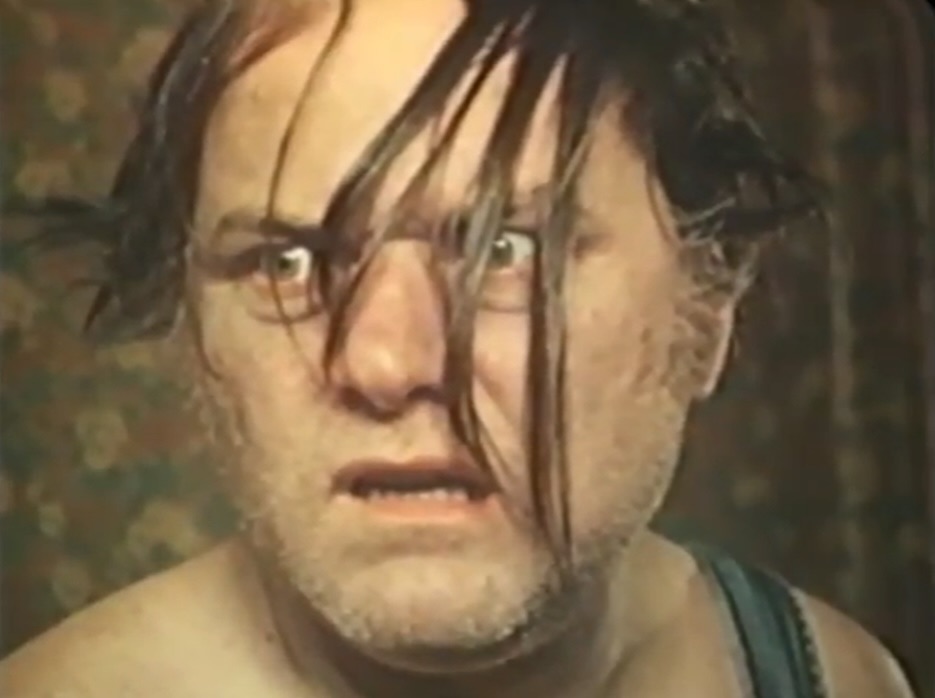
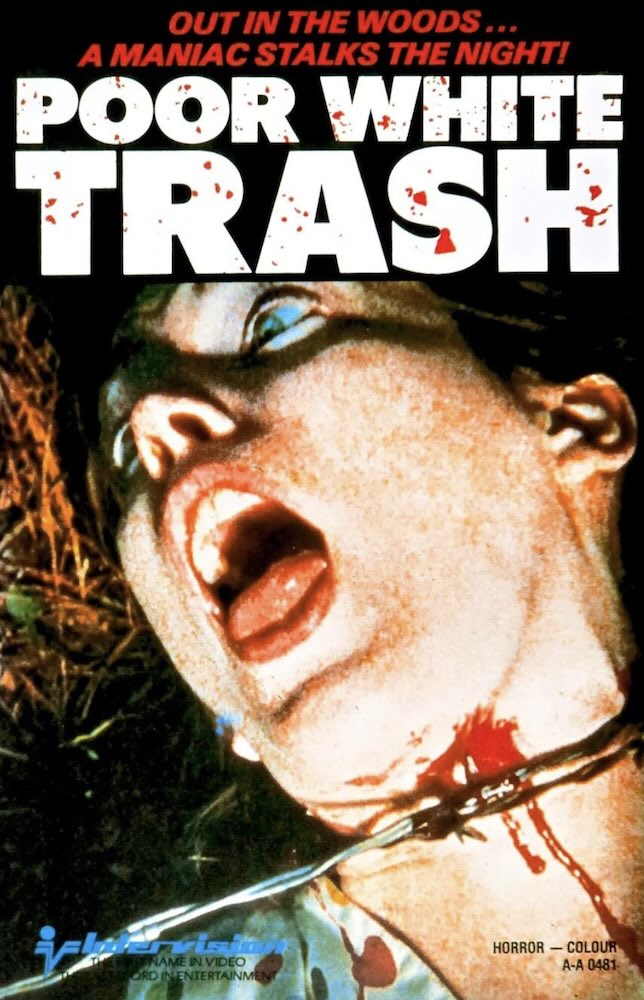
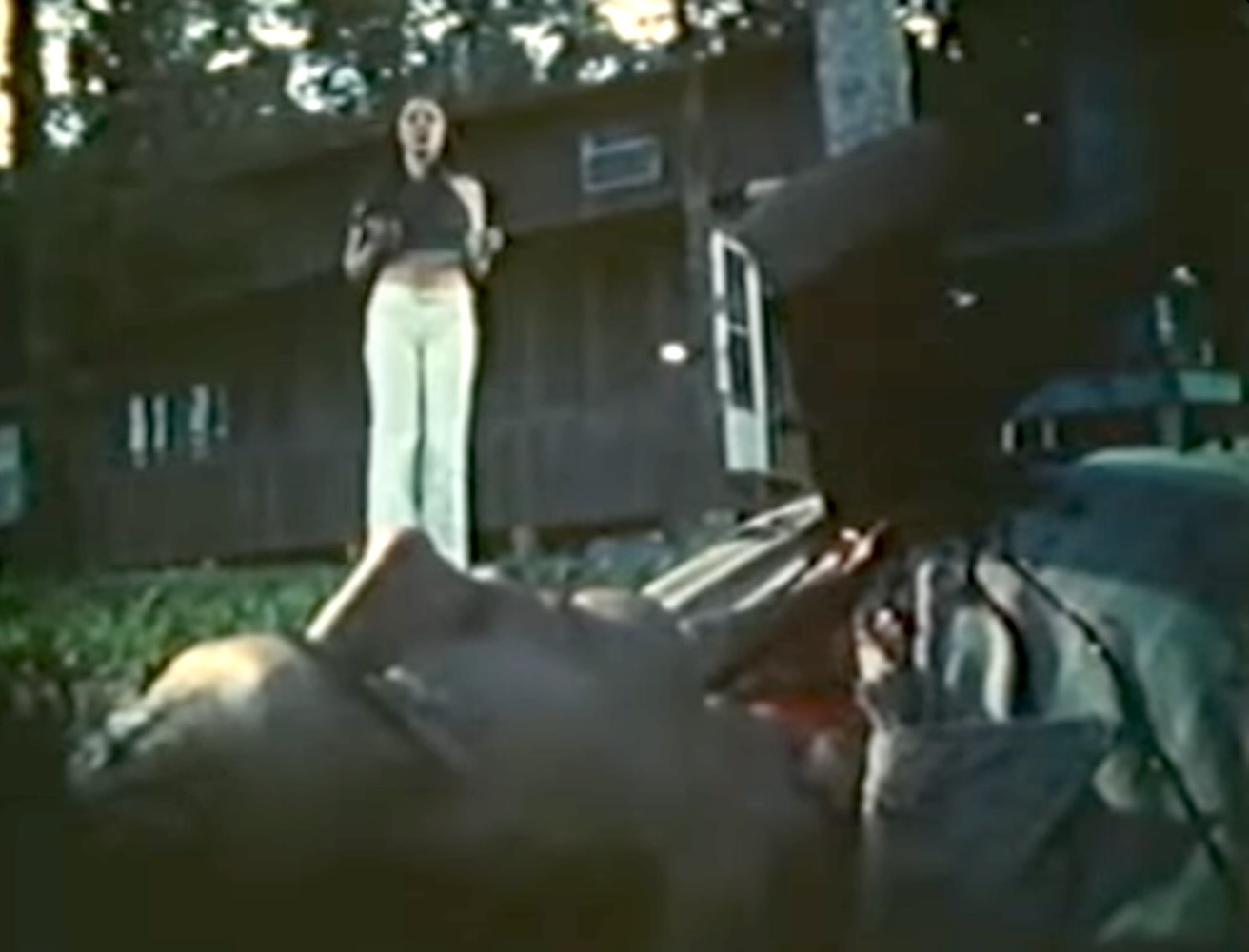
As with most proto-slashers, POOR WHITE TRASH II doesn’t quite conform to the template set by HALLOWEEN (1978) and FRIDAY THE 13TH (1980), but it is easy to see how it might have influenced later slashers—especially the latter, with its POV camerawork peering from behind trees and one-by-one gory murders by a mystery assailant (the film even features an escaped lunatic of sorts). The film also pre-empts the country-vs-city trope, often seen in later slasher movies, and was likely inspired by John Boorman’s DELIVERANCE (1972). It is also the first time Brownrigg explores sexual perversion (Odis’ incestuous desires), a ripe vein he would plough more fully in later titles.
Some might find the film’s midsection a bit talky by today’s standards, with a kind of hillbilly kitchen-sink aesthetic. However, the acting is generally good enough to flesh out these mostly unsavoury characters and keep the audience engaged in Helen’s plight. Ross is especially noteworthy as the odious Odis, with his sweaty fumblings and unruly combover (which seems to take on a life of its own). Whilst at times he acts with the broad strokes of a silent-movie villain, elsewhere he shows remorse and even grief, in a performance that is decidedly not one-note. Norma Moore, as Helen, is also effective as the damsel in distress (though it seems unlikely that she is the actress of the same name, as most listings of this film suggest, who acted with Anthony Perkins in FEAR STRIKES OUT (1957)).
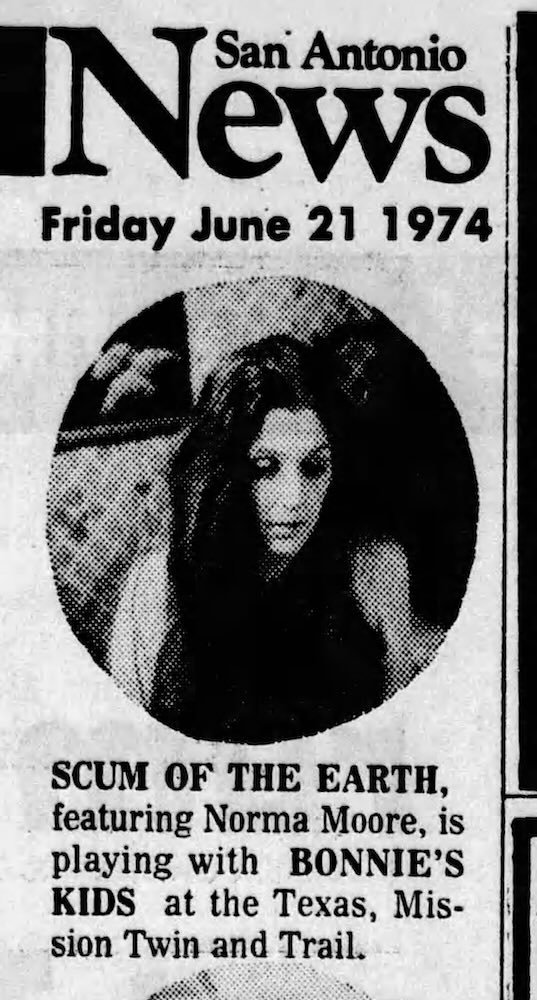
Envisaged under the title DEATH IS A FAMILY AFFAIR (reflecting the lyrics of the theme song sung by Peyton Park), the film was made over three weeks in 1973 in an old cabin in Mexia, East Texas (standing in for the Louisiana Bayou) and was in production around the same time as Tobe Hooper’s THE TEXAS CHAIN SAW MASSACRE (1974). The film was executive-produced by Walter L. Krusz, who also produced Brownrigg’s previous film DON’T LOOK IN THE BASEMENT (1973). Somewhat confusingly, it was initially released to screens as SCUM OF THE EARTH in the summer of 1974 (which was also the title of a 1963 exploitation number by Herschell Gordon Lewis). However, echoing the retitling of Brownrigg’s previous film, it was then re-released under its better-known name POOR WHITE TRASH II in the summer of 1976. This falsely suggested it was a sequel to the film POOR WHITE TRASH (itself a retitling of the 1957 film BAYOU, which ran on drive-in circuits in re-release in the early 1960s with extra sex and shock footage spliced in). Even more shameless was the publicity that declared it was “In the tradition of GODFATHER PART II and WALKING TALL PART II”! To add another touch of confusion, the film was released as POOR WHITE TRASH (sans part II) on video in the UK in July 1983. Miraculously, given its gory cover, it was not prosecuted as a ‘video nasty’, unlike the fate that befell Brownrigg’s first film.
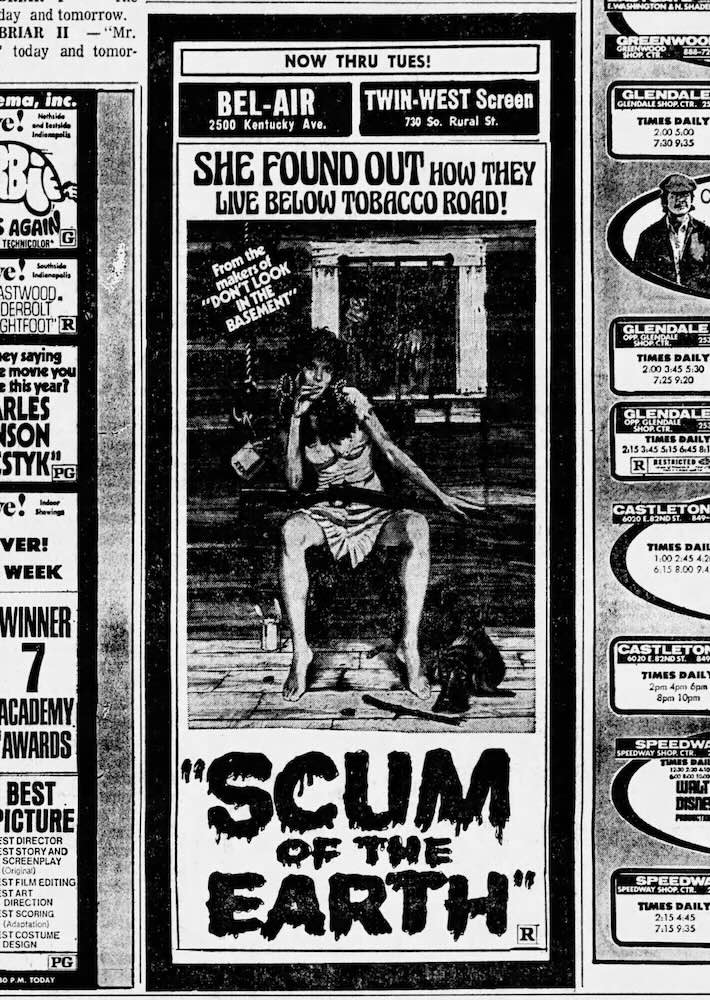
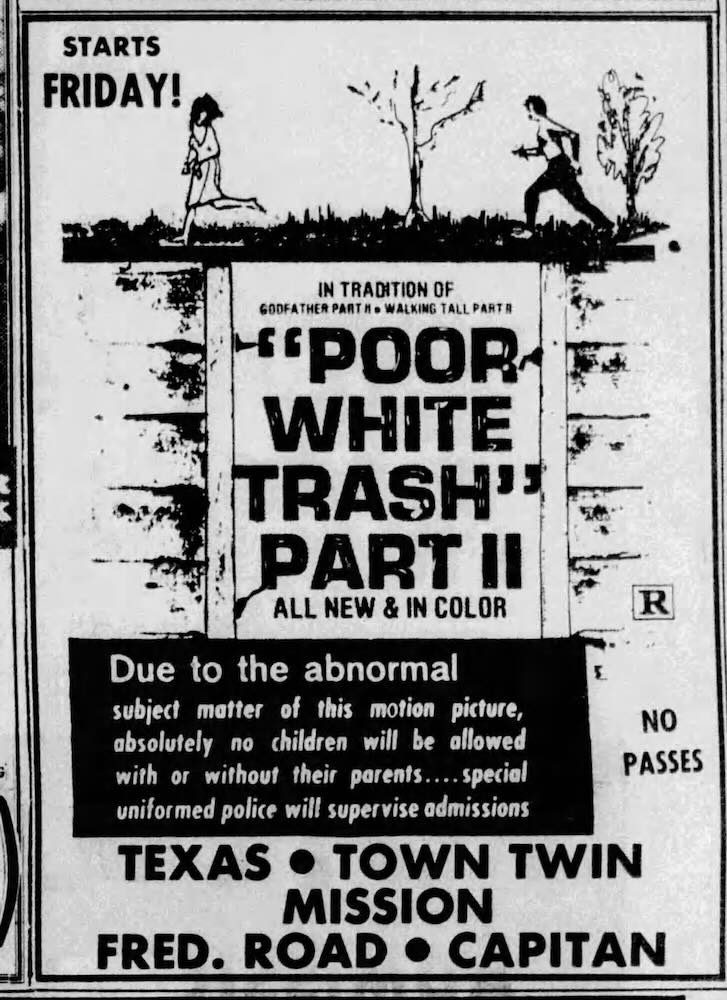
During the film’s 1976 release in North America, the distributors ran a unique promotion, posing fake policemen at entrances to allegedly stop children from seeing the film, warning: “Due to the abnormal subject matter of this motion picture, absolutely no children will be allowed with or without their parents... special uniformed police will supervise admissions.” Some drive-ins actually had a poor, bored-looking schmuck dressed as a cop (one critic noted one fast asleep during a showing), but distributors admitted it was just a gimmick and that they wouldn’t turn away paying customers with children in tow. Eric Gerber, in The Houston Post, went looking for these pretend law enforcers, but spoke to one ‘candy girl’ at a theatre who said they showed up only for one day and that the film wasn’t even that “nasty”. Gerber surmised: “I decided what was most abnormal about ‘Poor White Trash, Part II' was how the woman was raped with her blue jeans still zipped up.”
Brownrigg’s films were never known for critical acclaim, and POOR WHITE TRASH II was no exception. Linda Gross, writing in The Los Angeles Times, called it a “foul exercise in imbecility” and a “mindless plethora of gore, punctured bodies and sexual assault.” However, she praised some of the performances, saying, “Camilla Carr possesses an interesting neurotic-lethargic quality, and Ann Stafford is impressively passive and sensitive.” Desmond Ryan, in the Philadelphia Inquirer, noted that rather than fake cops, fake hillbillies held placards outside theatres warning that children were not allowed to see the film. However, his review was even more savage, saying, “With the debris and refuse mounting in the city streets, we scarcely deserve such garbage as ‘Poor White Trash, Part II’, a squalid little movie that lives up to at least two-thirds of its title. Poor? Certainly. Trash? Positively.”
In hindsight, this critical mauling all looks pretty hysterical and unwarranted, and is a good reminder that low-budget horror movies rarely received good notices. However, it shouldn’t detract from the fact that, whilst not perfect, Brownrigg’s film remains a scuzzy, effectively low-fi, backwoods classic of its kind and required viewing for anyone who would like to see how the slasher movie as we know it today coalesced in the grindhouses and drive-ins of the first half of the 1970s.
BODY COUNT 5:
Female 1 / Male 4
POOR WHITE TRASH II (trailer)

Thank you for reading! And, if you've enjoyed this review, please consider a donation to help keep Hysteria Lives! alive! Donate now with Paypal.