


UK, 1969
Review: JA Kerswell
David Bowie playing a moon-crazed psycho who hacks up fellow '60s pop star Scott Walker with a curved machete? It nearly happened. Despite its better-known title, all the talk of ghosts and ghoulies is a cover for a swinging London psycho-shocker that predates many of the future tropes of the Golden Age of the slasher movie in the late 1970s and early 1980s. A bored group of fashionable young friends decamp to an abandoned mansion to continue a party one night, only for one to be bloodily dispatched by a mystery assailant—and every time they return in an effort to unmask the culprit, more die in gruesome ways.
The early part of the film centres on a love triangle between handsome young man-about-town Gary (Mark Wynter), his girlfriend, Dorothy (Carol Dilworth), and his old flame, Sylvia (Gina Warwick). Sylvia has her own troubles: a much older ex-lover, Bob (George Sewell), is stalking her and won’t accept that their affair is over. In a perhaps unlikely turn, Sylvia accepts regular lifts in Bob’s car (which I guess is cheaper than a taxi). Gary arranges to meet Dorothy at a house party hosted by a mutual friend, Peter (Richard O’Sullivan), but he drinks too much and passes out dead drunk on a bed upstairs after he arrives. Fellow partygoer Sheila (Jill Hayworth) declares the gathering a dud, prompting Richard (Julian Barnes) to suggest they split and head out to a creaky old mansion for a spot of ghost hunting to spice up the evening.
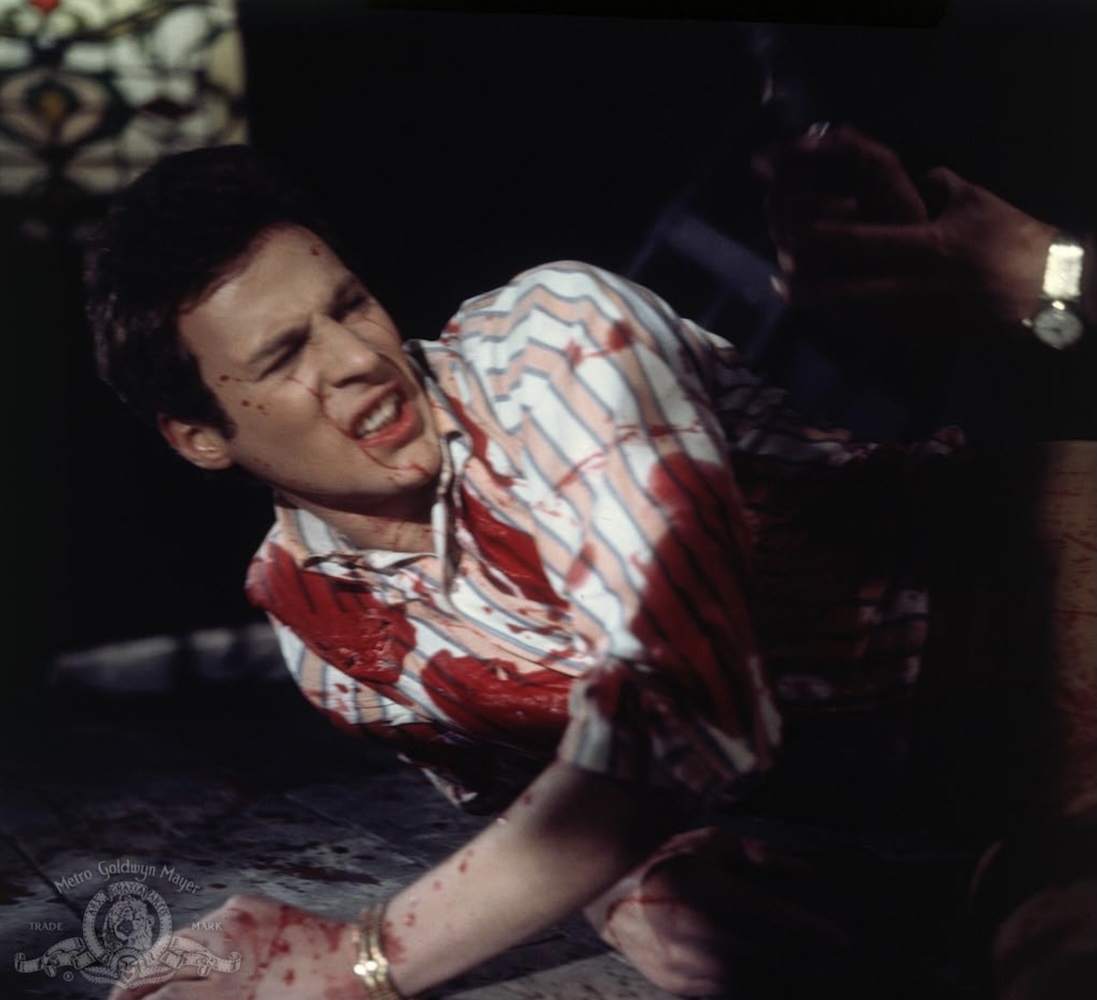
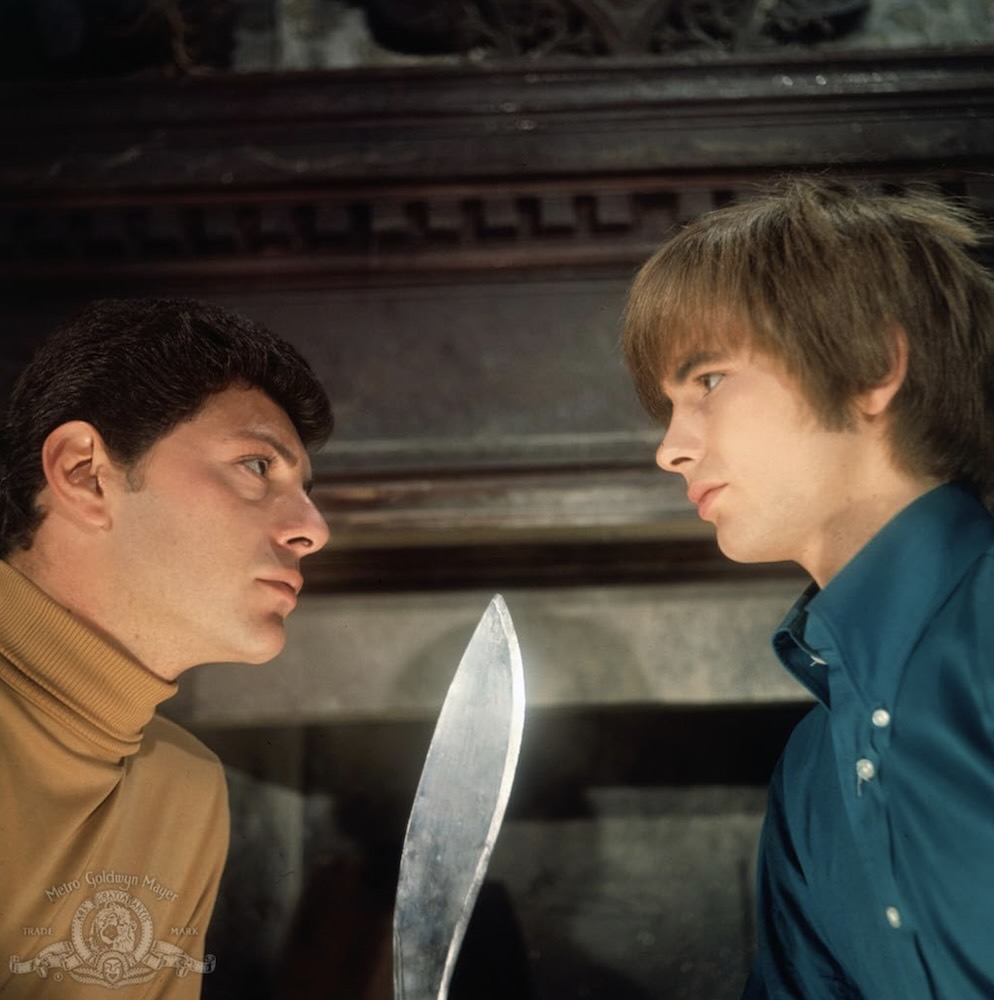
The group, including token American Chris (Frankie Avalon), takes two cars out to the tumbledown place outside the city in the wilds of the countryside. Once inside, under the light of a full moon, Richard tells the group the place is haunted by a man who murdered his entire family before committing suicide twenty years earlier. They debate whether to have an orgy or a séance, plump for the latter, then, after finding candles, decide to split up and go exploring (“The moon’s full. C’mon, let’s hunt for ghosts!”)—but not before Sylvia decides to head back into the city. Soon afterward, out of the darkness, someone wielding a curved scimitar brutally murders Gary, and his bloody body is quickly discovered by the others. Panicked and suspicious that the murderer is one of them, the group conspires to hide Gary’s body for fear they will all be blamed.
Within a few days, Gary is reported missing, and the police begin their investigation. Soon, they hone in on the group because of a past-year drug bust. However, the friends keep their secret for now. Bob—who followed Sylvia and the group to the house that night—questions her about a lost lighter; although she knows nothing about Gary’s death, she thinks she may have dropped it there, which leads him to go look for it, only to be stabbed to death by the mystery killer.
As cracks begin to show in the group and some teeter on confessing to the police, Chris unwisely suggests they make one last attempt at uncovering the killer's identity by returning to the mansion. The moon is full, as it was on the night of the murder, and not all of them will live through the evening …
With THE HAUNTED HOUSE OF HORROR, director Michael Armstrong juxtaposes the pop art and mod fashions of late 1960s Carnaby Street with the creaky Dark Old House formula of the 1930s, featuring a deranged killer lurking within. However, there is a sense that the decade’s optimism has curdled, with a cynicism and a sense of boredom about the superficiality of modern culture at the time, which pre-empts the chaos, darkness, and edginess of the early 1970s.
Like most proto-slashers, Armstrong’s film is surprisingly prescient, predicting tropes that would emerge a decade later (including its brief opening with a point-of-view camera shot from the killer’s perspective), while also understandably diverging from a formula that hadn’t yet been set. Perhaps most obviously, the film presumably influenced the later HELL NIGHT (1981), another teen thriller that took a bunch of good-looking young people and killed them off one by one in the typical Old Dark House. Both feature an establishing legend of a madman who slaughtered his family and may still lurk somewhere inside (either in flesh or as a murderous specter). However, while the film flirts with the supernatural, the threat is very much human and essentially plays out as a psycho whodunnit. THE HAUNTED HOUSE OF HORROR also predates the ill-fated pacts to keep a tragedy secret seen in later slasher movies, such as I KNOW WHAT YOU DID LAST SUMMER (1997). It is also surprisingly gory for a film of its time, with the slashing murder of Gary especially prolonged and cut in a similar way to the shower scene in Hitchcock’s PSYCHO (1960)—an obvious nod by Armstrong, whose first draft for the film dates to that year, written when he was just fifteen years old. Where the film perhaps deviates from the norm is its truncated narrative, with events unfolding over the month after Gary’s murder rather than in a single, extended sequence at the mansion over one night of mayhem.
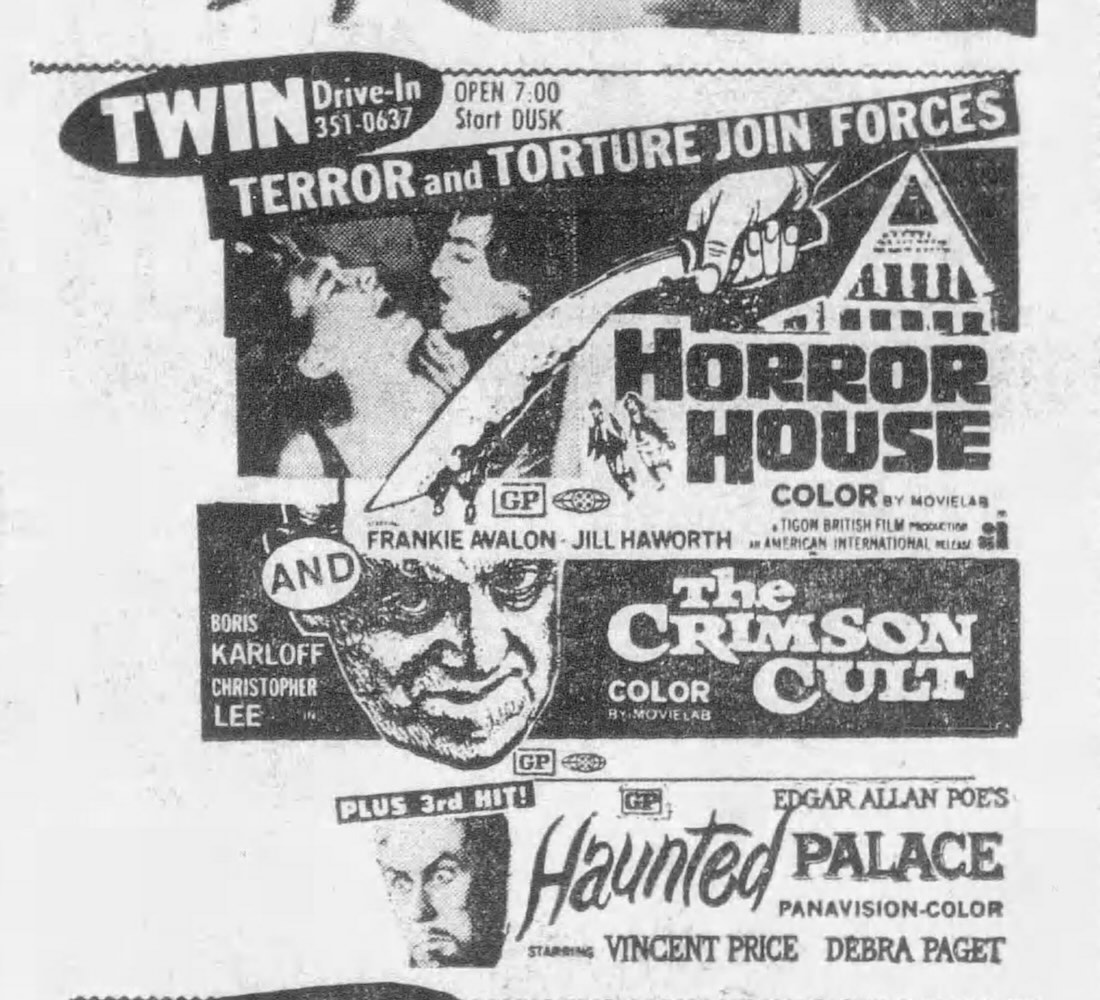
Filmed as THE DARK in 1968, it was mostly shot not outside Swinging London but at a derelict hotel in Southport, Merseyside (it was demolished the next year). The production was famously troubled, with an acrimonious relationship between Armstrong and executive producer Louis M. Heyward leading to many battles on set and numerous reshoots (by another director). It is a small miracle that the finished product hangs together as well as it does. It was released to British screens the following year, with a last-minute title change to THE HAUNTED HOUSE OF HORROR (it received a Stateside bow under the perhaps more apt truncated title HORROR HOUSE). As part of the promo for the British release, competitions were held for single women to watch the movie alone in a cinema at night—one winner was Mrs. Veronica Muzeen of Reading, who said she had enjoyed it but had “seen better horror films.” Kevin Thomas, in the Los Angeles Times, liked the movie, saying it “[transcended] formula plots through exceptional scripting, efficient direction and intelligent performances.” Otherwise, it was largely dismissed as formulaic camp—something of an irony given its trendsetting ways.
One of the original choices to play the film’s killer was the then little-known pop fledgling David Bowie. It’s not as far-fetched as it might seem; Armstrong had directed Bowie in the short film THE IMAGE the previous year. However, American International Pictures (which put up the money and co-produced it with the British studio Tigon) ultimately vetoed Bowie, fearing that his casting would clash with their American star, Frankie Avalon (who was under contract to AIP and was pushing thirty when he shot this; the critic in the Tulsa World called him “the world’s oldest living teen-ager”). In hindsight, the decision to nix Bowie was shortsighted; it seems odd that they were protecting Avalon’s image, considering he exits the film with a scimitar to his crotch! Scott Walker—of The Walker Brothers and then solo fame (his Scott 2 album was a N01 hit in 1968)—was offered the role of Gary (the film’s first and bloodiest victim) but ultimately turned it down. Reluctant British Scream Queen Jill Haworth is fun as the petulant socialite who gets her own chase scene around the mansion, pursued by the scimitar-wielding killer in the film’s climactic scenes. Haworth went on to appear in two other proto-slashers in 1972: TOWER OF EVIL and HOME FOR THE HOLIDAYS. American producers were initially insistent on casting Boris Karloff as the police detective, but due to his failing health, they suggested putting him in a wheelchair racing around the mansion in pursuit of the killer (which would have been strangely prescient of Charles Gray in THE ROCKY HORROR PICTURE SHOW (1975)). Karloff was ultimately too ill to take part, and British character actor Dennis Price stepped in.
Frankie Avalon got his own slice of early ‘80s mayhem in Alan J. Levi’s 1982 slasher BLOOD SONG, where he stars as a flute-playing psycho who develops a psychic link with a teenager played by Donna Wilkes and starts a deadly game of cat and mouse with her.
Armstrong achieved further infamy with his next movie, the notorious MARK OF THE DEVIL (1970) with Udo Kier. Incidentally, the director aimed to capitalise on the very subgenre he helped birth in 1980 with the unrealised THE ORPHANAGE, which was very much intended as a British version of John Carpenter’s HALLOWEEN (1978). He returned to similar territory with three short films that were combined into the anthology SCREAMTIME (1983), which featured the supernatural slasher segment DREAMHOUSE. With a sense of symmetry, Armstrong also worked with fellow British director Pete Walker as a writer on a couple of projects (HOME BEFORE MIDNIGHT (1979) and the Old Dark House semi-spoof HOUSE OF THE LONG SHADOWS (1983)). It seems very likely that Walker’s series of proto-slashers—including THE FLESH AND BLOOD SHOW (1972) and FRIGHTMARE (1974)—were inspired by Armstrong’s trend-setting 1969 psycho-shocker.
BODY COUNT 3:
Female 0 / Male 3
HAUNTED HOUSE OF HORROR (1969) video review
HAUNTED HOUSE OF HORROR (1969) trailer
Thank you for reading! And, if you've enjoyed this review, please consider a donation to help keep Hysteria Lives! alive! Tip me via Ko-Fi. (and get advance access to reviews and other exclusives!)