Japan, 2007
Review:JA Kerswell
Kōji Shiraishi, best known for the excellent paranormal pseudo-documentary NOROI: THE CURSE (2005), here delivers a typically off-kilter Japanese slasher movie centered on abuse that cascades down the maternal line. It feeds off a popular urban legend about a woman with a slit mouth who, in this version, carries a massive pair of scissors and hunts, abducts, and murders children. While blessed with a highly distinctive villain and some genuinely unsettling moments, muddy plotting, flat cinematography, and some highly illogical plot turns keep it from approaching top-tier Asian horror.
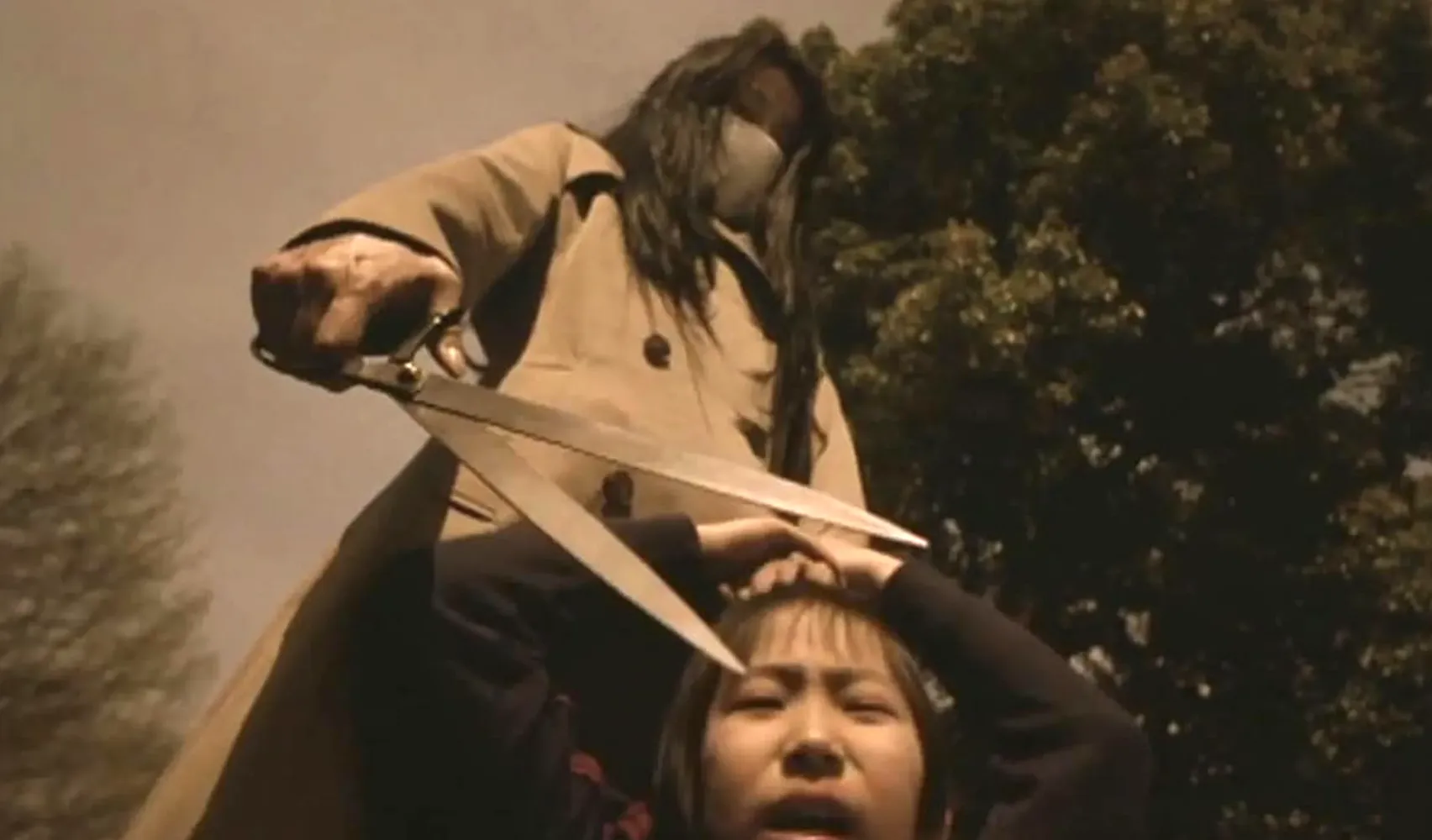
A city in Japan is awash with the legend of the Slit-mouthed Woman (or Kuchisake-onna) (played by Miki Mizuno as Taeko Matsuzaki), whispered about by children and adults alike. A Banshee of sorts, she wears a beige raincoat, carries a pair of terrifyingly long scissors, and sports a surgical face mask that, when removed, reveals a horizontally slit, mutilated mouth. Legend has it that she lives in a house with a red roof, where she keeps the children she abducts in a basement. However, after an earthquake rocks the prefecture, one of three small boys who hope to catch a glimpse of the urban legend at a park gets more than he bargained for when she proves to be terrifyingly real and is abducted by the Slit-mouthed Woman, or by someone dressed like her. In the town over, officials warn children not to talk to strangers and arrange for them to walk home in groups, as the police work on the assumption that the abduction is the work of an imposter.
One young girl, Mika (Rie Kuwana), is teased by classmates that she is the Slit-mouthed Woman because she sports a surgical mask (which she actually wears to hide the bruises her mother left on her face after beating her). Another girl in her class and her teacher, Kyōko (Eriko Sato), take pity on her. However, when Mika tells Kyōko (who is herself in a bitter divorce battle over her own young daughter, who despises her) that she hates her mother, Kyōko snaps at her despite the girl’s evident injuries. Mika flees and inadvertently runs into the arms of the Slit-mouthed Woman, who abducts her; but Kyōko, terrified by her appearance, cannot tell the authorities exactly what has happened.
Kyōko is suspended from her teaching position and told to rest and keep a low profile. However, as she leaves the school, another teacher, Noboru (Haruhiko Kato), asks her about her encounter. He says that every time a child is abducted, he hears a ghostly voice asking, “Am I … pretty?” He shows her a photo of a woman from 30 years ago who resembles the Slit-mouthed Woman. Together, they go to Masatoshi's (Yûto Kawase) home, a young boy from their school who has been researching the legend. When they arrive, he is attacked by the presence wielding her scissors, and they fight to save him. However, after she seemingly dies from a stab wound, they are shocked to see that the apparition has been replaced by a local woman and mother of two young girls.
As the child disappearances escalate—and the first abducted child is murdered and found dumped in a parking lot—the pair realise they must race to uncover the origins of the Slit-mouthed Woman to defeat her and rescue her remaining victims …
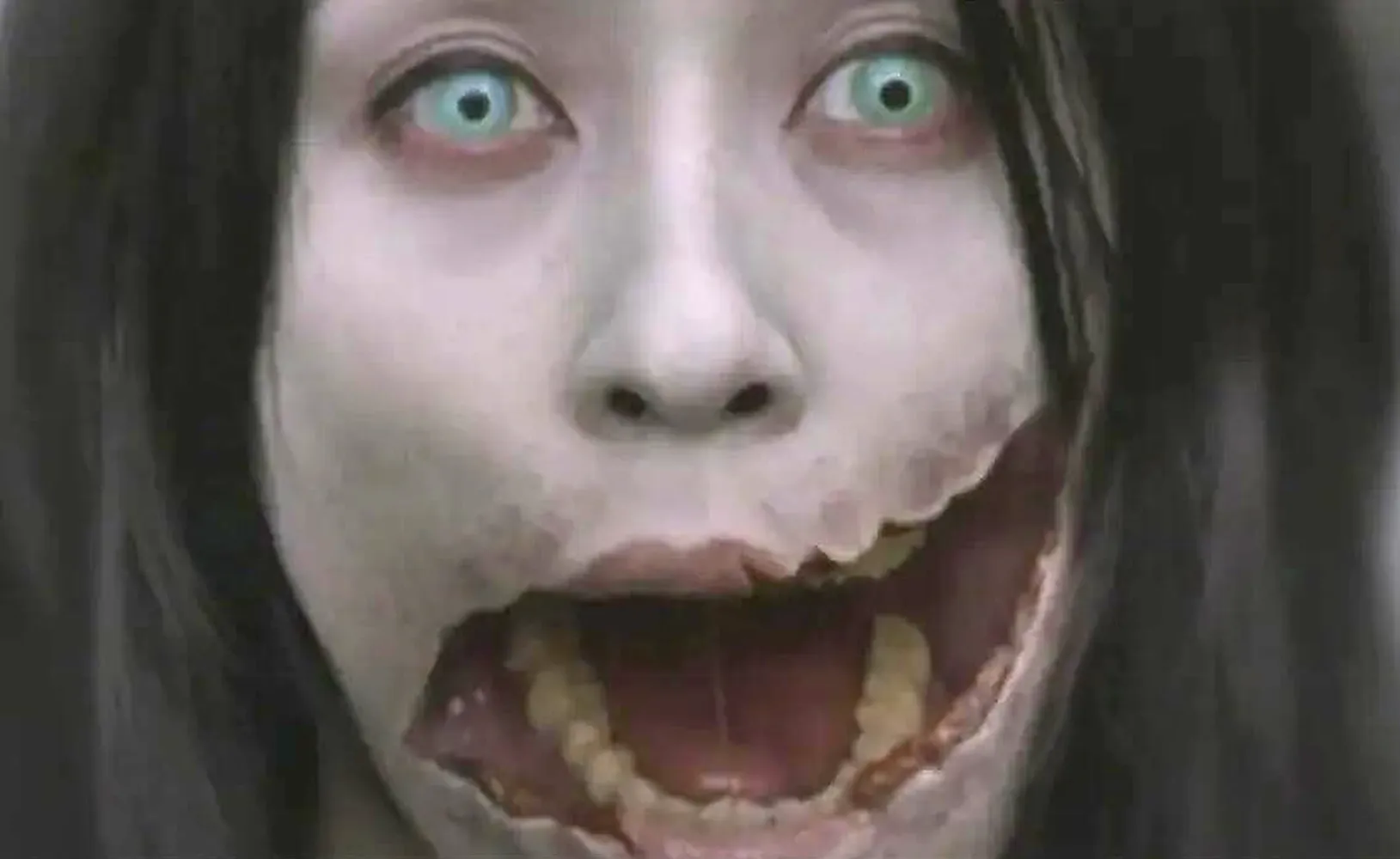
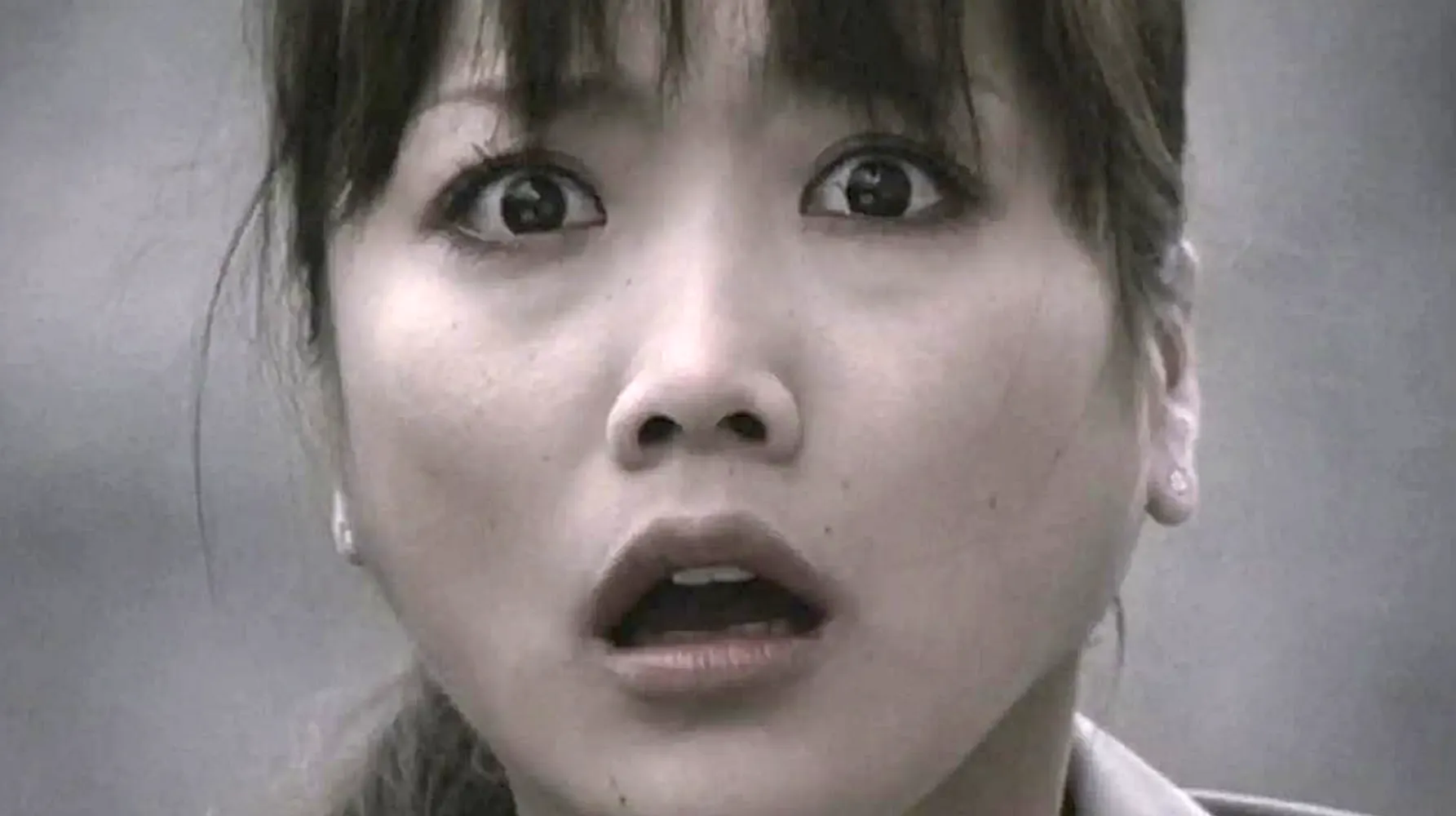
In Japan, the legend of the Kuchisake-onna, by some accounts, dates back to the 17th century (usually about a woman disfigured by her samurai husband to destroy her beauty as punishment), but the latest incarnation was popularised in the late 1970s by newspaper reports of sightings, when it became a craze among children to scare each other with the story, leading to near mass hysteria. As with most legends, variations proliferate, but most versions depict a woman mutilated in life who returns as a vengeful spirit. In Shiraishi’s version, she is a mentally ill mother who beats and eventually kills her children; who, in a moment of lucidity, begs her remaining child to behead her—which instead results in her facial disfigurement before she is eventually stabbed in the neck.
CARVED: THE SLIT-MOUTHED WOMAN treats its villain as a cross between a curse and a contagion (an idea previously used in better-known Japanese horror films such as Hideo Nakata’s RINGU (1999) and Takashi Shimizu’s JU-ON: THE GRUDGE (2002), two movies that spawned their own franchises centered on a long, black-haired female ghoul). Rather than the curse of the fathers, Shiraishi explores a curse of the mothers—in which even good-natured women become surrogates for the film’s monster (their possession heralded by a bout of coughing), who regenerates every time the host is killed. Mizuno’s Kuchisake-onna is cruel, robotic, and expressionless. She erupts into bouts of scissor stabbings as the film moves into a more slasher-centric second half, but more disturbing are flashbacks of her punching, kicking, and slapping her small children—something she continues to do even as a supernatural creature when she isn’t wielding her scissors. However, her staccato movements and leisurely pacing don’t necessarily make for the most dynamic slasher-movie villainess—and it’s clear that the director’s interests lie more in a more typically J-Horror, supernatural angle.
As with many Japanese genre pieces, the film tends to lean into the esoteric. Not all questions are answered—such as why the earthquake has resurrected the Slit-mouthed Woman and why she turns from a rotting zombie into a facsimile of herself from when she was alive. That’s fine, of course, but decisions such as the two protagonists not being questioned by the police after a random woman is found stabbed to death in a child’s house tend to unanchor the film somewhat. Although shot flatly (its smaller budget showing at times), it still has production values good enough to set it apart from many of the straight-to-video horror titles that proliferated in Japan.
Released to Japanese cinemas on limited release, Shiraishi’s CARVED: THE SLIT-MOUTHED WOMAN is one of the relatively few Asian movies that blend the legend of the long black-haired ghost with slasher-movie theatrics. Other post-SCREAM examples include NIGHTMARE (akaHORROR GAME MOVIE) (2001, South Korea) and GUROZUKA (2005, Japan). The character appears in the earlier Japanese straight-to-video horror anthology KUCHISAKE-ONNA (1996) and in the erotic, Pinku-charged THE SLIT-MOUTHED WOMAN (2005).
It was followed by the lesser-known but more accomplished THE SCISSORS MASSACRE (akaCARVED 2) (2008), directed by Kôtarô Terauchi. It is a prequel—at least thematically—offering an alternative origin story for the Slit-mouthed Woman. Set in 1978 (the year the original sightings, press reports, and hysteria started in Japan), it follows a popular schoolgirl who is facially disfigured with acid in a case of mistaken identity. Her growing estrangement from family, love interest, and former friends (who see her as a freak) drives her into depression and isolation, as a series of vicious murders by a woman in a red coat carrying scissors rocks the countryside. Notable for sudden tonal shifts (starting as a sweet teen drama before veering into shocking violence and a supernatural slasher finale), it features good production values (with great period details), solid acting, and an unpredictable narrative, making it a much more satisfying watch than the first film. Shiraishi himself returned to the theme with the first installment of his popular paranormal pseudo-documentary series, SENRITSU KAIKI FILE KOWASUGI FILE 01: OPERATION CAPTURE THE SLIT-MOUTHED WOMAN (2012). Along with other Asian remakes, four Japanese directors made an anthology in Los Angeles in the hopes of capturing a modicum of success of those US studio remakes of the likes of THE RING (2002) and THE GRUDGE (2004) with SLIT MOUTH WOMAN IN LA (2014).
Although it has its moments and features a memorable villain, Shiraishi’s follow-up to NOROI: THE CURSE unfortunately doesn’t evoke the same genuine unease and scares as that film—but the sequel/prequel, especially, is definitely worth hunting down.
BODY COUNT 4:
Female 3 / Male 1
CARVED: THE SLIT-MOUTHED WOMAN (2007) Trailer
THE SCISSORS MASSACRE (aka CARVED 2) (2008) Trailer