USA / Canada / UK
Review: JA Kerswell
Jane Schoenbrun’s TEENAGE SEX AND DEATH AT CAMP MIASMA is part love letter to ‘80s slasher movies and part fever-dream exploration of queer desire and otherness. In other words, it will divide audiences, but it offers rich rewards for those willing to go along for the wild, often hallucinatory ride filled with a veritable sweet shop of Easter eggs for fans of the subgenre.
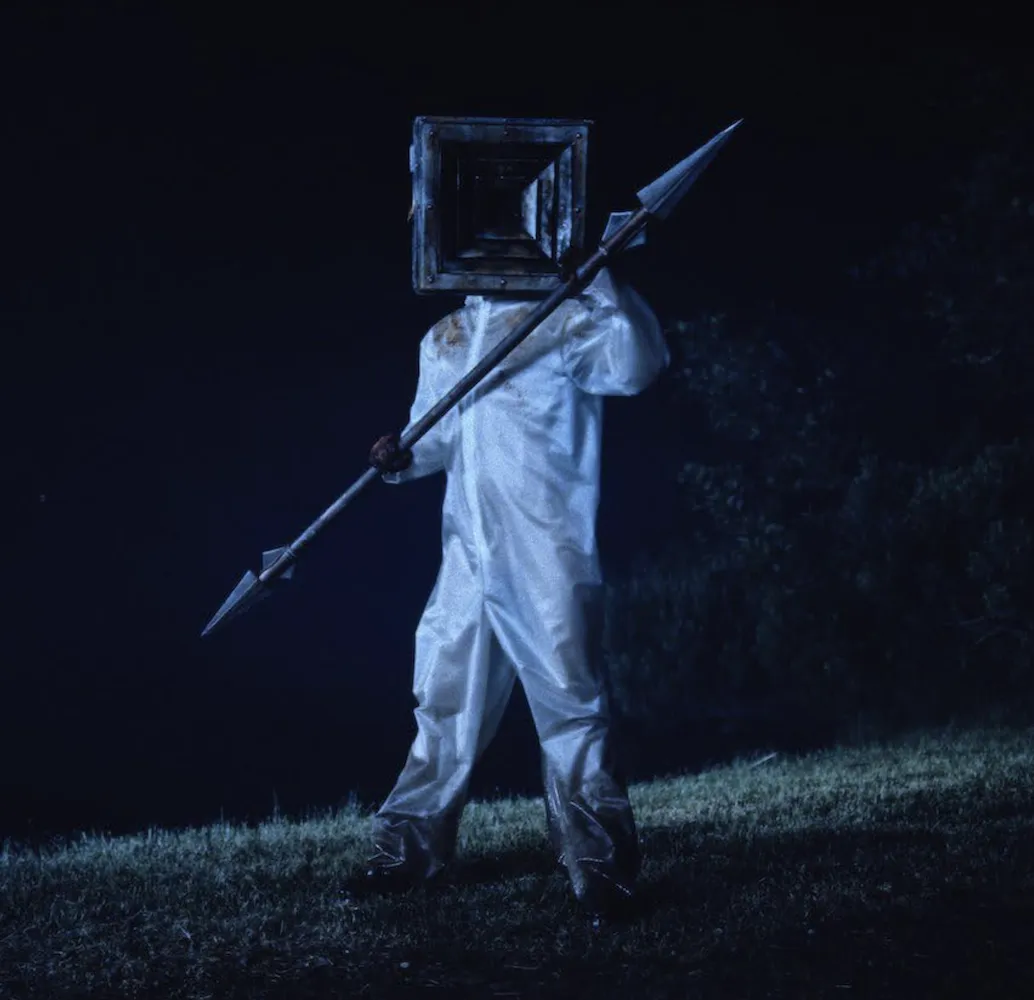
Kris Williams (Hannah Einbinder) is a 29-year-old filmmaker tasked with rebooting the once-popular CAMP MIASMA slasher franchise, featuring an iconic, diminutive killer, Little Death (Jack Haven), who carries a spear and wears a box-head mask. The series, which began in 1980, follows a child raised by hermaphrodites who lives half the week as a boy and the other half as a girl. The child was drowned by fellow campmates for being different and later re-emerges from the lake next to the camp to kill horny teenagers, sequel after sequel. Kris tracks down Billy Presley (Gillian Anderson), the star of the first film who turned down its 1981 sequel and vanished from public life. After agreeing to a meeting, Kris finds her at snowbound Camp Tivoli, the series’ filming location, where she now lives in isolation, working on geometric paintings inspired by the killer’s mask.
Kris tells Billy she’s been hired by a studio interested in a cinema revival of a series that slipped into straight-to-video hell but now has renewed, bankable nostalgic value. However, the studio executives are aware that the franchise is seen by many as problematically transphobic, and they hope a queer director can circumvent criticism for a new installment. As a fan of the series, Kris tells Billy she intends to explore the interplay of queerness and media’s representation of monstrosity—and wants her to come out of retirement to star in the reboot. However, while not declining, Billy shows generational differences of opinion, saying the films in the series were simply interested in baser instincts and had no subtext. Kris, who is unfulfilled in a polyamorous relationship, eventually admits that she is secretly both repulsed and turned on by the politically incorrect elements that made the series so popular.
Realising that the pair have more in common than they thought, Kris and Billy become tentative lovers. However, Kris is disappointed that the studio—which wants a straight-ahead origin story—doesn’t want her to make Billy the star of the reboot. She further alarms the executives when she reveals that she now believes Little Death is real, lives in a hole at the bottom of the lake, and is about to return to kill again …
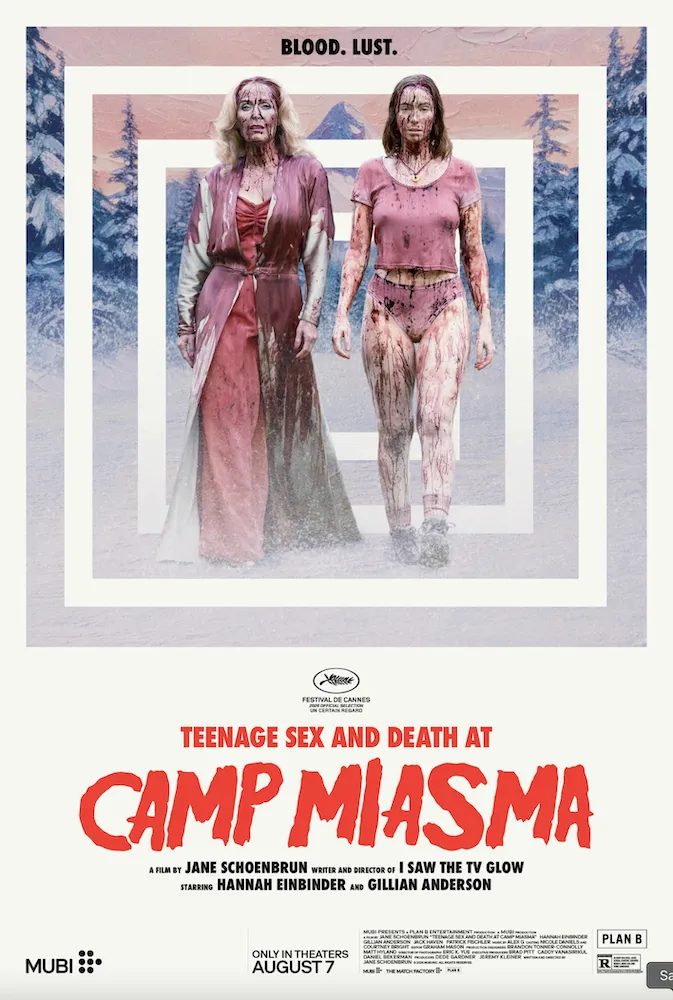
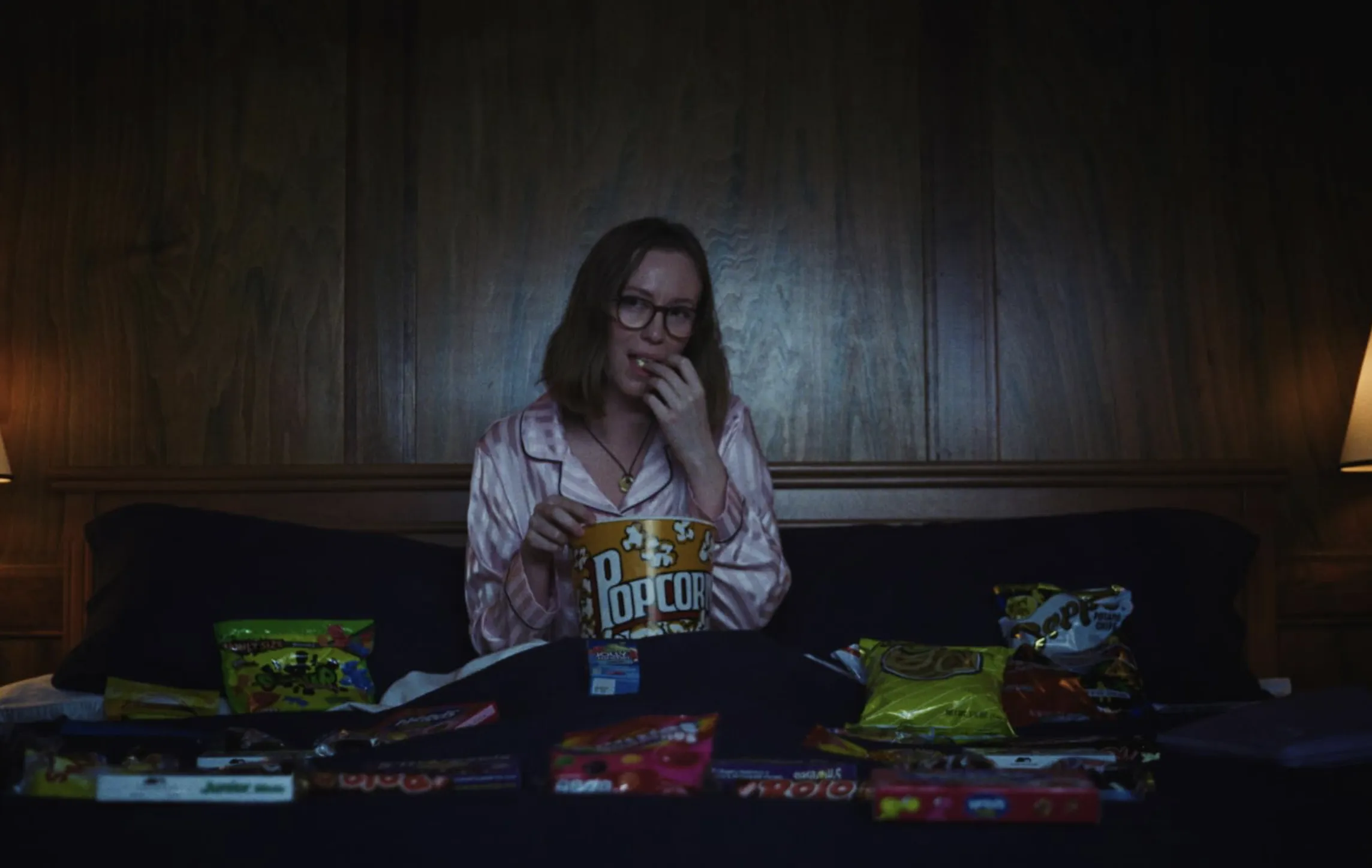
Hannah Einbinder is exceptional portraying the awkward and conflicted director, as is Gillian Anderson, who comes across as a Norma Desmond type (complete with a black turban), despite her character claiming she’s not—whose paintings of the killer’s mask are presumably inspired by Adrienne King (the Final Girl in 1980’s
FRIDAY THE 13TH, who still often paints the climactic lake scene from that film).
TEENAGE SEX AND DEATH AT CAMP MIASMA wears its FRIDAY THE 13TH,
THE BURNING (1981), and especially
SLEEPAWAY CAMP (1983) influences on its sleeve. Whilst Schoenbrun retains the singular vision of their previous films WE’RE ALL GOING TO THE WORLD’S FAIR (2021) and I SAW THE TV GLOW (2024), it is evident that their latest is shot through with genuine affection and knowledge of the subgenre, from the lovingly crafted memorabilia for the fictional series shown in its opening credits (complete with FRIDAY THE 13TH style font) to little touches such as the killer’s Michael Myers-esque head tilt. Schoenbrun also widens their influence to the stranger side of early ‘80s horror, with nods to David Cronenberg’s VIDEODROME (1983).
Whilst the film perhaps subverts our expectations of what we think a slasher movie should be, Schoenbrun doesn’t shy away from stylised violence that the subgenre is known for (with neck stumps spouting purposefully orgasmic geysers of blood like something out of
SHOGUN ASSASSIN (1980)), and the director recreates scenes from the series with evident glee. Billy and Kris watch reels of the first film together, which features Little Death emerging from the lake and commencing a rapid-fire massacre of campers (most notably the hapless camp counselor who gets the spear up his backside and is smashed against a lamp post until his body explodes in an avalanche of gore). Although, like many recreations of early ‘80s slashers, there are certain flubs that can’t help but pull you out of the moment if you notice them (such as the use of a digital camcorder in a film supposedly set in 1980).
However, these subgenre elements circle Schoenbrun’s main interest: exploring the repressed desires of its two leads, who overcome a generational divide to find love and common ground. It also explores their—and the audience’s—identification with the Final Girl and the killer (who here is something of a Queer avenger). It is also a celebration of both sex and death (the two selling points of many slasher movies). Little Death (the translation of the French term la petite mort, which refers to the brief moment of detachment following an orgasm) brings extermination, but also sexual emancipation for the chosen. Ultimately, in Schoenbrun’s movie, the two lead characters only truly live after they are killed and reborn. Potshots are taken at both sides of the so-called culture war, though it ultimately ends with transgression winning.
Some of the elements in TEENAGE SEX AND DEATH AT CAMP MIASMA may remain a bit too obtuse, such as Kris’ obsession with children’s junk food and the reason the woods surrounding the camp take on the painterly appearance of an illustrated children’s storybook. Sure, it looks cool, but the film never clarifies whether this is meant to be Kris's hallucination—or perhaps the whole movie is a hallucination.
The film’s funniest scenes (it is ostensibly intended as part comedy) come from elements undoubtedly informed by the director’s experiences in the industry, where agents and studio executives mask discomfort and dissatisfaction through non-committal sword salad (evidenced by a particularly awkward group Zoom call). The somewhat ironic thing is, of course, Schoenbrun secured $10 million to make their highly individual and arguably anti-commercial take on the subgenre with this film.
A certain sense of unreality and dreamlike logic may irk those looking for a more straightforward take—again, this isn’t a typical slasher movie (although, without giving too much away, the film closes with another mini murder spree when Little Death makes good on Kris’ prediction and returns to camp).
TEENAGE SEX AND DEATH AT CAMP MIASMA works best if you surrender to its fairy-tale ambiance—and its woozy internal logic. However, even if it isn’t for you, there’s no denying it is a unique, admirably agitprop take and further evidence of the subgenre’s ongoing resonance and adaptability.
BODY COUNT 21:
Female 11 / Male 10
TEENAGE SEX AND DEATH AT CAMP MIASMA (2026) Trailer