


USA, 1980
Review: JA Kerswell
A thoroughly depressing and ultimately empty—if occasionally fascinating—exercise in 42nd Street Grindhouse psychosexual sleaze. After a young man accidentally kills a sex worker, he refuses to learn from his mistakes and heads for the grimiest corners of late ‘70s New York City to perve and then kill and then kill again. At the very least, interesting to see an early film from director Joseph Zito before he made the higher profile slasher movies THE PROWLER (1981) and FRIDAY THE 13TH: THE FINAL CHAPTER (1984).
Ritchie (Ian Scott), a small-town teenage schmuck, visits an older local sex worker, Bev (Judith-Marie Bergan), to solicit her services. However, during a mild disagreement, he pushes her, and she falls against a window, which breaks, cutting her throat. Panicking, he attempts to clean up and hide her body as her boyfriend Johnny (James Johnson)—who happens to be a local cop—comes by. Ritchie evades detection (despite moving the body out of the house in a wheelbarrow) and disposes of it. However, even though Bev had warned Johnny that she might split town at a moment’s notice, he is suspicious that something nefarious has happened to her, which is hardly surprising given that one of her windows has been smashed.
Fearing detection, and mumbling something about “She was beautiful … she disgusted me", Ritchie hitchhikes into New York City and heads straight for the sleaziest, craziest section around 42nd Street with its glowing neon porno palaces; his inner monologue continues to mumble something about them never finding him in the urban jungle. He rents a fleabag room in a dirt-cheap tenement block and impassively watches the casual street violence and vice from his window. Surrounded by hustlers (both male and female), the lost and the vulnerable, Ritchie is soon up to his old tricks and exploits his new hunting ground (wearing, presumably ironically, John Lennon-style round glasses). His first victim is a female piano player from a strip joint, whom he humiliates by nearly drowning her in her own bathtub and then forcing her to bash out a tune on her bontempi organ; then strangling her with her telephone cord as the strip club owner berates her for being late back to work. It’s a dispiriting, dehumanising scene that pretty much evaporates any hope that BLOODRAGE will be anything other than a would-be titillating roughie. Despite John Carpenter’s HALLOWEEN coming out the year before, this isn’t an effort to ape that movie’s approach to suspense (a wasted opportunity, perhaps, given that Zito proved he was adept at it with his later slashers); it is more along the lines of the likes of skeezy psycho roughies such as THE DARK RIDE (1979) and DON’T ANSWER THE PHONE (1980). Your mileage may vary depending on whether you enjoy those examples.
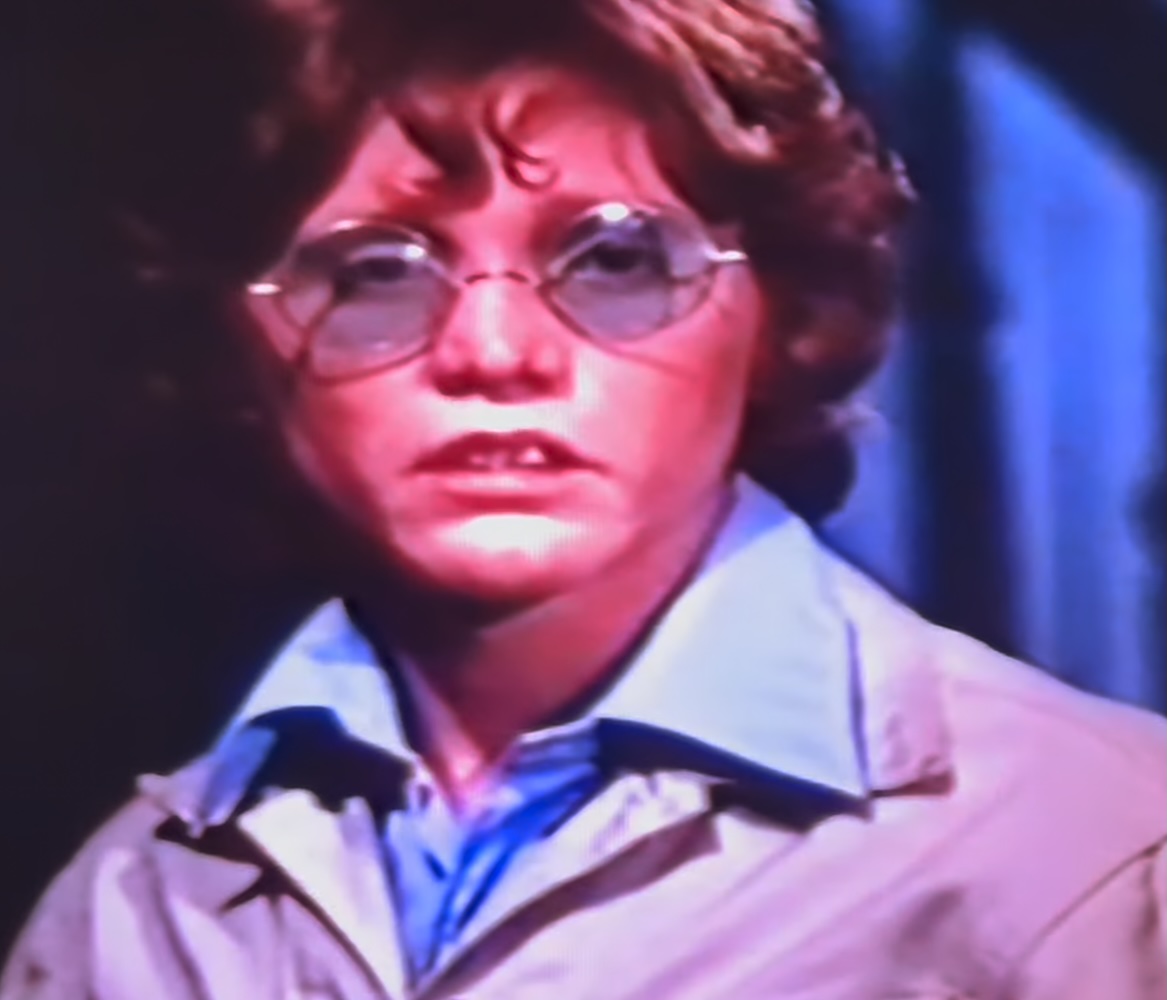
BLOODRAGE—which Zito directed under the pseudonym of Joseph Bigwood—is a frustrating watch. He seems inspired by Martin Scorsese’s TAXI DRIVER (1976), especially by Ritchie’s inner monologue (the two films even share some peripheral cast). There are even some allusions to Roman Polanski’s THE TENANT (also 1976), with a man watching Ritchie expressionless from a window opposite. However, there’s no serious intention (nor presumably interest) in digging into Ritchie’s damaged psyche; there is little attempt to explore the character’s psychosis beyond the fact that he is driven to humiliate and then kill women. At one point, he considers seeing a doctor, but this self-reflection is a dead end. Arguably, the best psycho villains elicit even a smidgeon of sympathy or fascination as they spiral, but Ritchie just comes across like a weirdo brat. Quite apart from his woman-hating ways, he is additionally even more detestable when he snaps the neck of a small dog (obviously fake) and throws the body through a plate-glass window to the street below. It is some small satisfaction that he suffers a similar fate at the movie’s hurried close.
The film makes some feeble efforts at a traditional thriller narrative, with Johnny, the cop on Ritchie’s tail, following him to the Big Apple, presumably on the hunch that Bev has gone there. However, it’s weak sauce linking interminable scenes of sex workers stripping and grinding and dancing unenthusiastically around their apartments for their Johns under posters of kittens and John Travolta—before Ritchie turns up to kill them. In this way, it mirrors the penny slot peepshows that used to line 42nd Street, so I guess it’s somewhat fitting yet hardly thrilling. However, where BLOODRAGE is most interesting (and presumably where Zito’s fascination primarily lay) is its snapshot of New York City at that point in the late 1970s. One of the movie’s best vignettes is a scene where Ritchie gets into a lift with a little person, and they watch a pimp and a sex worker have a violent argument in front of them. Another standout is the vodka-chugging good time girl, Candice (Rita Ebenhart), who comes across like an eccentric Warhol Superstar boasting about partying with Mick Jagger. She takes Ritchie into her apartment in the same tenement block and talks constantly without pausing for breath, which adds to the city's constant din of sirens and yells, which was more fully utilised in Abel Ferera’s DRILLER KILLER (1979) as an irritant and background hum driving mental collapse.
The movie’s soundtrack—allegedly written by Michael Karp and performed by the band Canine Tricycle Bereavement—is a mishmash of Bernard Herrmann impersonations and library-sounding music from 1940s thriller serials (which, admittedly, gives the film an off-kilter, often discombulating air).
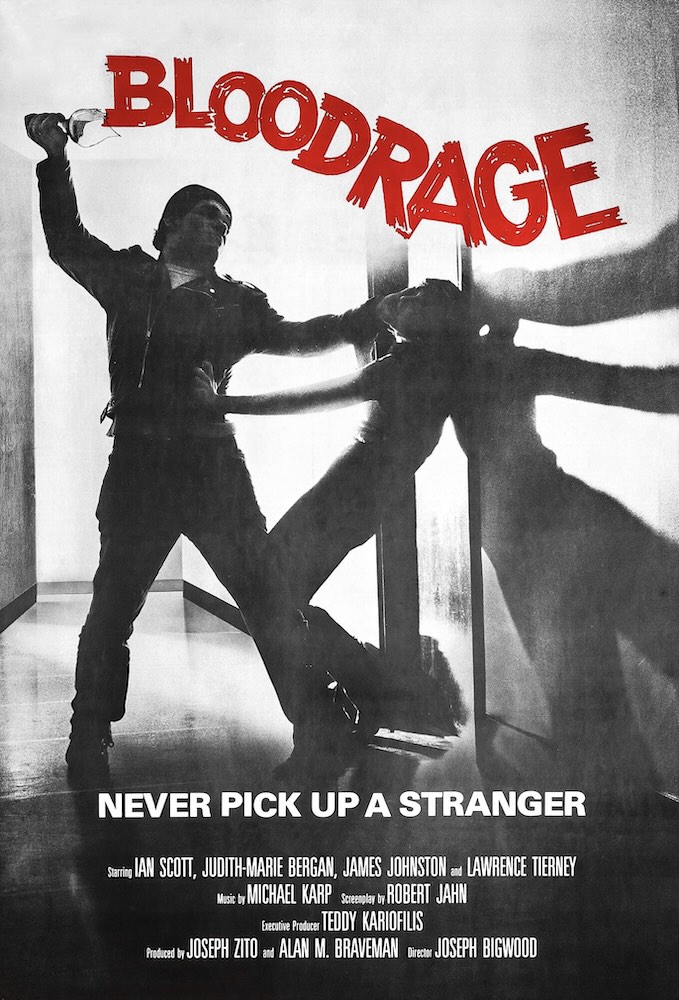
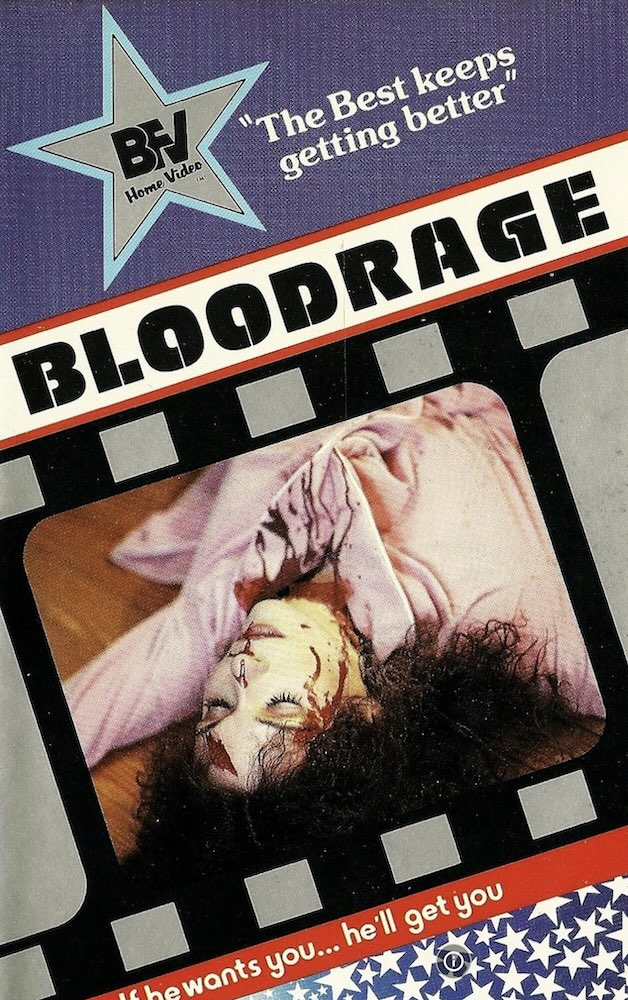
BLOODRAGE was filmed primarily on location in New York City in late 1979. The only recognisable members of the cast are veteran actor Lawrence Tierney in little more than a cameo (he also appeared in Zito’s later THE PROWLER) and Judith-Marie Bergan, who played the first victim, who went on to a long career in TV. It was featured at the Cannes Film Festival in May 1980, seeking international sales. There is some confusion over any cinema release in North America. I haven’t been able to find any listing for the film under that title, nor its oft-quoted alternative, NEVER PICK UP A STRANGER. On promotional artwork, the latter appears to be a tagline rather than another title (depicting an image of a man attacking a woman with a broken bottle that bears no resemblance to anything in the movie, but may have been used to make audiences think this was more like the other slasher movies of 1980 than it actually was). It is possible that Zito’s movie played where it was shot—on very limited release in 1980 on 42nd Street. However, it is so obscure that it doesn't even appear that a trailer exists. It did, however, get mentioned multiple times in the press (under its longer title) as an example of the type of horror movie that was proliferating in 1980. Although released on video in the UK in 1982, just as the so-called ‘video nasty’ hysteria was starting, the film flew under the radar and continues to do so today with no high-res digital release in sight.
BODY COUNT 5:
Female 3 / Male 2
Thank you for reading! And, if you've enjoyed this review, please consider a donation to help keep Hysteria Lives! alive! Tip me via Ko-Fi. (and get advance access to reviews and other exclusives!)