(page
2)
It
was around this time that reaction to some of the publicity turned sour.
Media pundits had noticed, not without some interest, that Haxan Films
and Artisan had managed to reach a section of society that it had long
been believed were immune from the wily charms of a more conventional
marketing campaign- the Generation X and Y'ers. The net literate twenty
and thirty somethings had discovered the film by word of mouth and from
glowing fan reviews that appeared
 |
 |
all over the web;
but it was number of deliriously positive rantings that appeared in
the newsgroups and feedback forums at movie sites, that aroused suspicion
that some of them may be as bogus as the film makers, now tongue-in-cheek,
assertion to the genuine nature of their movie. Certainly, more seasoned
contributors to alt.horror, myself included, noticed that regularly,
for a couple of months, glowing one-off posts would be made by people
who were never heard of again. Myrick and Sanchez have, however, denied
that this method of net marketing was used as a way to promote their
film- at least, to their knowledge. There were also charges of plagiarism.
Irked by the seemingly universal praise for the film's 'originality',
some genre commentators pointed out the uncanny similarity between Myrick
and Sanchez's movie and Ruggero Deodato's 1979 film CANNIBAL HOLOCAUST,
a film which also uses 'found footage'- this time of a group of mondo
film makers who, after much bloodshed of their own making, fall victim
to retribution at the hands of a cannibal tribe in the Amazon. Myrick
and Sanchez deny being aware of the movie and its main plot device-
something which is not unreasonable, as, although the film gained a
certain notoriety in the mainstream consciousness in the UK as a 'video-nasty',
in the States it remained pretty much an obscure midnight movie. Also,
in CANNIBAL HOLOCAUST the 'found footage' is accompanied by scenes,
which make up the bulk of the movie, where another film crew go looking
for the missing film makers- a dual narrative approach that Myrick and
Sanchez rejected. Perhaps more interesting is another low budget film
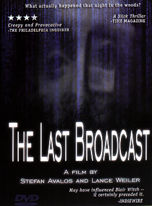
from the States called THE LAST BROADCAST (www.tebweb.com/lastbroadcast/),
the plot of which is remarkably similar to THE BLAIR WITCH PROJECT.
The film, which amazingly cost only $900 and was edited on a home computer
by writer-directors Stefan Avalos and Lance Weiler, is the story of
a three person cable-TV crew, that go into a forest (the New jersey
Pine Barrens) in search of evidence of a legendary monster- the Jersey
Devil. The film was slated to appear at the 1998 Sundance film festival
(a full year before THE BLAIR WITCH PROJECT made its appearance),
but was pulled from the schedule for reasons unknown. Both films were
shot in 1997, but it is unclear if one influenced the other in any way-
THE LAST BROADCAST is in-fact more similar to THE CURSE OF
THE BLAIR WITCH psuedodocumentary. Even so, there were rumours that
Avalos and Weiler were considering plagiarism charges against the Myrick
and Sanchez, but with so many unsubstantiated rumours appearing on the
web it is often difficult to separate fact from fiction.
Despite,
or perhaps because of the growing controversies surrounding the film,
Artisan quickly became aware that they had a potential hit on their
hands; but dealt with the distribution coolly- keen to keep the film's
image as an underground sleeper, but all the while increasing its profile
in the hope of a cross-over success. The film opened at the Angelika
Film Center in New York on July 13th, for an exclusive three day run
and, according to the press, caused scenes of near riots during the
rush to get tickets. On July 16th the film had a limited opening at
27 cinemas across the US, where, on its opening weekend, it pulled in
an incredible $1.5 million- a $57,000 per screen average, which managed
to top even THE PHANTOM MENACE's per screen average on its opening
weekend. Unable to refrain from comment any longer the mainstream press
began to really take notice and a month later, after the film had gone
wide to over a thousand screens and
 |
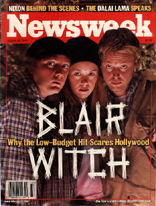 |
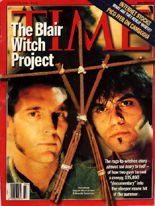
had made an astonishing
$50 million in its first week, the film was awarded the US media's highest
honour: it made the covers of both Newsweek and Time magazine on the
same week. Only an Oscar nomination would be more prestigious; it was
a concrete sign, as if it needed one, that THE BLAIR WITCH PROJECT
was a bone-fide cause celebre. Now, as the movie continues to approach
its projected final domestic box office take of $150 million, the BLAIR
WITCH phenomena shows no signs of abating. There are already a legion
of whispers about sequels or prequels (or both!), which Myrick and Sanchez
are sensibly distancing themselves from- at least as writer-directors;
their next project is apparently a screwball comedy in the AIRPLANE
mould. A stream of merchandising, something more usually associated
with the Hollywood big Blockbusters, has blossomed in proportion to
the film's success. Not only is there a book, which expands the mythology;
a comic; and even a CD with music that whilst none of which actually
features in the film, was supposedly taken from a tape found in Josh's
car; containing suitably spooky numbers from the likes of The Creatures,
Bauhaus and Lydia Lunch. But, as if to go from the sublime to the ridiculous,
when you visit the website www.blairwitchdirect.com you can order all
the merchandise mentioned online, as well as Blair Witch cigarette cases,
ashtrays, beanie hats (as worn by the missing students in the film);
and even a pewter chalice with the film's logo emblazoned on it.
Now,
as the film opens on these shores, you could be forgiven for perhaps
feeling a little cynical about it in the wake of the charges of plagiarism;
opportunistic merchandising; stories of patrons letting out blood curdling
screams in US cinemas- or rushing out to be sick (not because 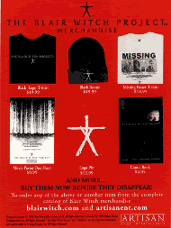 of
fear, but rather motion sickness triggered by the shaky-cam nature of
the footage); and the general hysteria surrounding the "scariest movie
ever made". You'd also be forgiven for wondering if it possibly could
live up to this kind of hype? Well, let me just start by saying that
no film can possibly live up the type of hype that THE BLAIR WITCH
PROJECT has been cocooned in, but, paradoxically it almost succeeds.
It is a powerfully manipulative, but very fine bit of film making; and,
although I realise that I'm adding to the hype by just saying so, it
is a film which should not, under any circumstances be missed. From
the very start, the rawness of the digital video camera and 16mm footage;
and the intimacy of the narrative banishes from the mind all the overblown
publicity. THE BLAIR WITCH PROJECT is an oddly engaging film.
Although we may not have the added angle many viewers had in the States,
that the footage was real (the appearance of the three protagonists
presenting an MTV music award recently kind of blew any remaining doubt-
although there are still a hardcore who insist it really did happen),
the footage does seem real. The performances are so natural; the breadth
of human emotion evoked so believably, that it is impossible not to
become emotionally involved. And, the bottom line, the film is scary.
The fore-knowledge that something bad will eventually happen to the
student film makers is enough to generate fear and tension from the
off; even seemingly innocuous early moments, like the snippet of interview
with a Burkittsville housewife, where her toddler trys to cover her
mouth to stop her talking about the Blair Witch, are imbued with a horrible
sense of foreboding. Believe me, I have never had so many goosebumps
as I did during this movie.
of
fear, but rather motion sickness triggered by the shaky-cam nature of
the footage); and the general hysteria surrounding the "scariest movie
ever made". You'd also be forgiven for wondering if it possibly could
live up to this kind of hype? Well, let me just start by saying that
no film can possibly live up the type of hype that THE BLAIR WITCH
PROJECT has been cocooned in, but, paradoxically it almost succeeds.
It is a powerfully manipulative, but very fine bit of film making; and,
although I realise that I'm adding to the hype by just saying so, it
is a film which should not, under any circumstances be missed. From
the very start, the rawness of the digital video camera and 16mm footage;
and the intimacy of the narrative banishes from the mind all the overblown
publicity. THE BLAIR WITCH PROJECT is an oddly engaging film.
Although we may not have the added angle many viewers had in the States,
that the footage was real (the appearance of the three protagonists
presenting an MTV music award recently kind of blew any remaining doubt-
although there are still a hardcore who insist it really did happen),
the footage does seem real. The performances are so natural; the breadth
of human emotion evoked so believably, that it is impossible not to
become emotionally involved. And, the bottom line, the film is scary.
The fore-knowledge that something bad will eventually happen to the
student film makers is enough to generate fear and tension from the
off; even seemingly innocuous early moments, like the snippet of interview
with a Burkittsville housewife, where her toddler trys to cover her
mouth to stop her talking about the Blair Witch, are imbued with a horrible
sense of foreboding. Believe me, I have never had so many goosebumps
as I did during this movie.
Watching
THE BLAIR WITCH PROJECT is a draining experience; a filmic endurance
test. It is not a film which you can view passively; it does not patronise
its audience by providing fully sequential information. By that I mean,
we- as the audience, only see, or hear, what Heather, Josh and Mike
do, when they have their equipment turned on; sometimes the screen is
so dark we can only hear their conversation- or their screams. Sometimes
they see or hear things that we do not- their equipment hasn't picked
it up, the sound of a baby screaming from deep in the dark woods for
example, but we know that they heard it; and we can only imagine what
it must have sounded like; and worse, what it can mean. Many people
don't 'get' THE BLAIR WITCH PROJECT, they are annoyed at the
lack of clarity; the resulting ambiguity and the lack of a clear cut
resolution; but it is these very qualities which can make the film such
a terrifying experience. Forced to use your imagination to fill in the
blanks, you can, if you allow yourself to be sucked into the film's
pseudo-reality, realise that the horror we imagine awaits the protagonists,
is much worse than anything the film makers could show us. They provide
us with the visual clues, but they make us work for our numerous chills.
And it is this very fact, that we become emotionally involved in the
unfolding horror via an unusual intimacy, and growing empathy with the
characters, that the film has a haunting resonance long after it finishes.
The creeping unease that lasts with the viewer, as horrible ambiguity
gives way to terrifying possibilities, can last for days.
THE
BLAIR WITCH PROJECT is a fine horror film, which signals a move
in the genre back to subtle psychological terror, and away from comic
book viscera; something which has long been overdue. In the UK, this
is the film to see this Winter.
CHAOS
MAGAZINE (where this article originally appeared)